Wednesday, January 29, 2014

Film Review: Chungking Express (1994)


In Chungking Express, the director, Wong Kar-wai, uses a variety of film techniques in order to convey the struggle of finding companionship. Kar-wai toys with plot structure, camera movement, and framing in order to show two separate love adventures. Kar-wai expresses how even in a city as busy as Hong-Kong, many people are lonely. Although these techniques can potentially leave viewers frustrated or confused, if one can fight through these frustrations, the end result is a satisfying experience.
Chungking Express consists of two separate stories told back to back. The first is about a Hong-Kong policeman, known as Cop 223, who is struggling to get over his ex-girlfriend, May, in addition the audience meets a drug smuggling women who is trying to fix a drug deal gone wrong. These two seemingly dis-connected stories meet when Cop 223 starts hitting on the mystery women at the bar. However it leads nowhere as the women is too tired and is taken to a hotel where she falls asleep, and Cop 223 leaves. The next story is about another man, Cop 663, and his struggle to overcome his breakup with a flight attendant. This story ends on a happier, yet ambiguous note as he falls for an employee of his favorite restaurant. The movie ends with them two in the restaurant, now owned by Cop 663, and him asking the female, Faye, where they want to fly too, however the viewers never hear the answer.

Kar-wai uses a handheld camera in order to convey the chaos and over-crowdedness of Hong Kong. When characters are on the move the handheld camera shakes and jolts the viewer around. However when inside, mainly in the snack food store, or in one of the cop’s residences, the camera is still and focused. Kar-wai does a tremendous job contrasting these two settings in order to convey how an individual can be lonely even when in such a vibrant, bustling city.
The mise en scène used by Kar-wai did a fantastic job of illustrating the disconnect between characters throughout the film. It was most prevalent during the scenes in which Cop 663 interacted with Faye.  When he goes to the restaurant Faye is cleaning the outside glass, Kar-wai films this shot from the perspective of Faye, with the glass separating them, the glass acts as a motif to show their separation. The restaurant counter acts the same as the glass in other scenes.
Overall Chungking Express is a film displaying loneliness in a large city. The director, Wong Kar-wai, uses framing, a handheld camera, and a non-linear plot line in order to display this, leaving the viewer with a film that shows the true effects loneliness has on a human being.
Director- Wong Kar-wai

Starring- 
Brigitte Lin- Women in Blond
Tony Leung Chiu-Wai- Cop 663
Faye Wong- Faye
Takeshi Kaneshiro- He Zhiwu, Cop 223

Year- 1994 (China), 1995 (UK), 1996 (U.S)

Length- 98 minutes (HK), 104 Minutes (U.S)

Country- Hong Kong


Tarentino: A Quick Look at Reservoir Dogs and Inglorious Basterds


Reservoir dogs
Reservoir dogs, directed by Quentin Tarantino is a film about a jewelry store robbery gone wrong.  It has a non-linear plot structure and does not come together until one of the last scenes. Tarantino doesn’t stray far from his love of violence, with multiple shooting scenes as well as torture.  This film is most unique in its strange balance of scenes. The scenes, in which violence plays a large role and are hectic, are contrasted nicely with long monologues or conversations between characters. These long dialogue scenes did get somewhat tedious, however they were contrasted nicely with the up-beat, dramatic scenes. In addition, the non-linear plot allowed for Tarantino to jump around and fit in different parts of the story when he chose to do so. One scene in particular which I felt was well done was this scene.
This scene starts immediately following the credits, the viewer has no prior warning and no context, this helps add to the drama and intensity. In addition the camera shot does not show the road, just the two men, and the driver, Mr. White, isn’t looking at the road. This again adds to the drama. Lastly what makes this scene special is how the dialogue contrasts the chaos of what the viewer sees. This helps in this scene and in many others, to balance out the violence.

Inglorious Basterds 

Inglorius Basterds is Tarantino's take on the holocaust and Europe in the 1940s. He remains relatively historically accurate until the ending scene in which Hitler is blown away by a baragge of bullets. Tarantino uses drawn out conversation and framing to build tension. The movie overall builds tension up until the final scene in which hell breaks loose. Tarantino's framing can be seen in this scene.

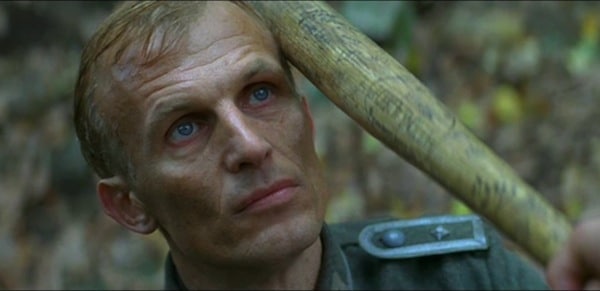
Tarantino uses 2 main shots in this. He has a close up of the german's face, which includes a slow zoom. This shot cuts back and forth with a slow zoom of a dark space. This dark space creates a feeling of mystery and uncertainty. The suspense builds as we as the viewer get deeper and deeper into the dark space. Tarantino creates a strange dynamic in this scene. He makes the audience empathize with the German, even though we want to see him as the enemy. We are just as uncertain as to whats behind that entrance as the German. When the "Bear Jew" finally does emerge, Tarantino immediately zooms out to give the audience a full look at the new character. We then see the German through his eyes instead of a third person view. This new camera angle is shot at a high angle, showing that the German is powerless.


Another way Tarantino builds tension is through long conversations. This can be seen multiple times throughout the movie. Many times it is the conversation itself, rather than the film techniques which helps add tension, but Tarantino is able to use a combination of both. 


Film Review: Rush (2013)


           Some may know the story of the Formula One season in 1976, most probably won’t, but everyone can appreciate this amazing story. Rush, directed by Ron Howard, follows two formula one racers, James Hunt, and Niki Lauda, through their respective careers and intense rivalry. Based on a true story Rush gives us insight into what its like to be a professional racer and the mental and physical toll associated with this profession. Director Ron Howard’s use of montage helps relay the intensity of racing, while the track acts as a third character, giving us a greater insight into Lauda and Hunt’s relationship and motivations.
Hunt is the archetypical party boy, drinking before and after races, keeping girls glued to each arm, and using his lack of common sense to go faster than the competition is willing too, constantly risking his life on the course. Lauda is the polar opposite, early to bed early to rise, Lauda spends most of his time out on the course practicing or in the garage adjusting his car to get it just right.

The two racers start off in a low level formula 1 league, the film follows them all the way to formula one. Once in formula one their rivalry only intensifies, with Lauda winning a title, forcing Hunt to look in the mirror and determine if its time for a change in his style. Next season with everything on the line, Lauda pushes himself too far, resulting in heinous crash. Many think his career is over however his passion for racing combined with his desire to beat Hunt brings him back to the track against all odds. The film leads up to one race in which everything is put on the line and the will of two men is tested.
Competition is the driving force of the film. The two racers compete with the track, each other, and death. The city is not a common setting in this film, however in many ways the racetrack acts as a city of its own. In many city films, the city takes on certain attributes and acts as another character. The track is dangerous, unforgiving, and isolates the racers. Hunt is willing to die for a victory, where as, towards the end of the film, we learn that Lauda values certain things in his life more than racing. The track acts as an extra character allowing us a greater insight into the minds and actions of Hunt and Lauda.
The use of quick-cuts and montage in Rush keeps the viewer interested and relays the danger of Formula One Racing.  Forumla One Races typically take about 90 minutes. In order to capture the intensity in a shorter amount of time, Howard uses extremely quick cuts, going from track to racer to crowd, etc. He combines this with montage, creating a montage of quick cuts, which helps recreate the Formula One atmosphere. Overall Rush is an exhilarating experience with a strong storyline that keeps viewers engaged and dying to see what happens next.
Directed By- Ron Howard
Starring-
Chris Hemsworth as James Hunt 
Daniel Bruhl as Niki Lauda
Olivia Wilde as Suzy Miller
Year- 2013
Run Time- 122 Minutes
Filmed in- UK, Germany, and Austria